Computing Decoded
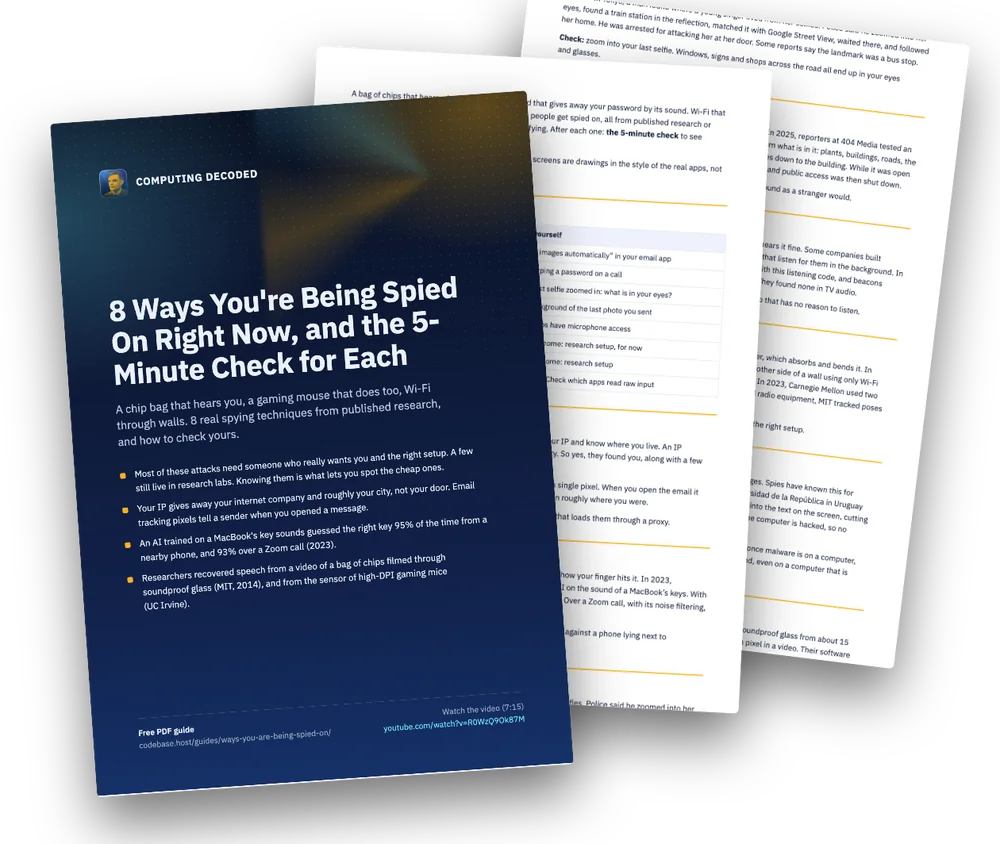
A bag of chips that hears what you say. A keyboard that gives away your password by its sound. Wi-Fi that sees you through a wall. These are eight real ways people get spied on, all from published research or reported cases, counted down from creepy to terrifying. After each one: the 5-minute check to see whether it works on you.
All drawings in the video and here are our own. App screens are drawings in the style of the real apps, not the apps themselves.
The 5-minute check
| # | Technique | Check it on yourself |
|---|---|---|
| 8 | IP links and email pixels | Turn off “load images automatically” in your email app |
| 7 | Keyboard sounds | Mute before typing a password on a call |
| 6 | Reflections in your eyes | Look at your last selfie zoomed in: what is in your eyes? |
| 5 | Photo location AI | Look at the background of the last photo you sent |
| 4 | Sounds you can’t hear | Check which apps have microphone access |
| 3 | Wi-Fi through walls | Nothing to do at home: research setup, for now |
| 2 | Your screen from next door | Nothing to do at home: research setup |
| 1 | Things that hear you | High-DPI mouse? Check which apps read raw input |
#8: “I have your IP”
A stranger sends a link, you click it, and they say they have your IP and know where you live. An IP address points to your internet company and, roughly, your city. So yes, they found you, along with a few million neighbours.
The same trick hides in emails. Many carry an invisible image, a single pixel. When you open the email it loads, and the sender learns that you opened it, when, and often roughly where you were.
Check: turn off automatic images in your email app, or use one that loads them through a proxy.
#7: Your keyboard talks
Every key sounds a little different, depending on where it sits and how your finger hits it. In 2023, researchers from Durham, Surrey and Royal Holloway trained an AI on the sound of a MacBook’s keys. With a phone recording nearby it guessed the right key 95% of the time. Over a Zoom call, with its noise filtering, it still got 93%.
Check: mute before typing a password on a call. Mute does nothing against a phone lying next to your keyboard.
#6: The reflection in your eyes
In 2019 in Tokyo, a man found where a young singer lived from her selfies. Police said he zoomed into her eyes, found a train station in the reflection, matched it with Google Street View, waited there, and followed her home. He was arrested for attacking her at her door. Some reports say the landmark was a bus stop.
Check: zoom into your last selfie. Windows, signs and shops across the road all end up in your eyes and glasses.
#5: Your photo knows where
Phones often strip the location from a photo when you send it. In 2025, reporters at 404 Media tested an AI tool called GeoSpy that guesses where a photo was taken from what is in it: plants, buildings, roads, the sun. No GPS, no metadata, and an answer in seconds, sometimes down to the building. While it was open to the public, some people asked it to help find specific women, and public access was then shut down.
Check: before sending a photo of your home, look at the background as a stranger would.
#4: Sounds you can’t hear
Many adults hear little above 17 to 18 kHz. A phone microphone hears it fine. Some companies built trackers that play short codes up there, called beacons, and apps that listen for them in the background. In 2017, researchers at TU Braunschweig found 234 Android apps with this listening code, and beacons playing in 4 of the 35 shops they checked in two European cities. They found none in TV audio.
Check: Settings, Privacy, Microphone. Remove access from any app that has no reason to listen.
#3: Wi-Fi sees you
Wi-Fi is radio bouncing around your home, and a body is mostly water, which absorbs and bends it. In 2018, UC Santa Barbara counted people walking in a room from the other side of a wall using only Wi-Fi signal power, and later counted people sitting still from their fidgets. In 2023, Carnegie Mellon used two ordinary routers to rebuild the pose of people in a room. With special radio equipment, MIT tracked poses through a wall in 2018.
Your router does not do this on its own: it takes special software and the right setup.
#2: Your screen, from next door
The cable to your monitor leaks a faint radio signal as the picture changes. Spies have known this for decades, but it took expensive gear. In 2024, researchers at the Universidad de la República in Uruguay used a cheap radio and an AI (Deep-TEMPEST) to turn that signal back into the text on the screen, cutting reading errors by more than 60 points against older tools. Nothing on the computer is hacked, so no antivirus sees it. Their suggested fix: noisy, colourful backgrounds.
In 2024 Mordechai Guri of Ben-Gurion University also showed RAMBO: once malware is on a computer, it can make the memory leak data as radio at about 1,000 bits per second, even on a computer that is never online.
#1: Things that hear you
With a camera. In 2014, MIT researchers filmed a bag of chips through soundproof glass from about 15 feet away. Speech makes everything in a room shake, by tiny fractions of a pixel in a video. Their software measured those shakes and rebuilt speech you could understand. Even an ordinary camera recovered some sound.
With your mouse. Gaming mice with very high DPI feel the desk vibrate when you speak. Games and apps read mouse data all the time. Researchers at UC Irvine (Mic-E-Mouse) cleaned that data with an AI and rebuilt speech, understanding roughly half of it. Their setup needed a mouse of 10,000 DPI or more and a desk that carries the sound.
Check: if you use a high-DPI mouse, notice which apps ask to read raw input, and keep it off a hard bare desk if you talk about sensitive things.
Sources
- Keyboard sounds: Harrison, Toreini, Mehrnezhad, 2023 (Durham, Surrey, Royal Holloway), reported by Malwarebytes.
- Tokyo, 2019: CBS News.
- GeoSpy: 404 Media.
- Ultrasonic beacons: Arp et al., 2017.
- Wi-Fi counting: UC Santa Barbara. Pose from Wi-Fi: DensePose From WiFi.
- Screen from radio: Deep-TEMPEST. RAM as radio: RAMBO.
- Chip bag: The Visual Microphone, MIT. Mouse: Kaspersky on Mic-E-Mouse.
Glossary
- Side channel
- Information that leaks from how a device works (sound, light, radio, timing), not from its normal output.
- Tracking pixel
- A 1x1 image in an email. When it loads, the sender's server learns that you opened the message, when, and your IP address.
- Ultrasonic beacon
- A short code played above about 18 kHz, too high for most adults to hear, that a phone microphone can still pick up.
- TEMPEST
- The old name for spying on a screen or cable through the radio waves it leaks.
- Air-gapped
- A computer that is never connected to any network, used for the most sensitive data.
- DPI
- Dots per inch: how finely a mouse sensor measures movement. Gaming mice go far beyond office mice.
Practice
Try these before opening the answers.
You get a link from a stranger on Discord. What is the worst they get if you click it, if you download nothing?
Your IP address, so your internet company and rough city, plus your browser and device type.
Your email app shows images automatically. What does a store learn when you open its email?
That you opened it, when, often your rough location from your IP, and sometimes your device. Turning off automatic images, or using an app that loads them through a proxy, hides most of it.
You post a selfie by a window. What two things could give away where you are, even with location turned off?
What shows in the background (signs, buildings, plants, road paint), and what reflects in your eyes or glasses.
Why does muting before typing a password protect you on a call, but not from a phone lying next to your keyboard?
Mute stops your microphone sending sound to the call. A phone nearby records the keys directly, and in the 2023 study that gave 95% accuracy.
Frequently asked questions
Can someone find my house from my IP address?
Usually not. An IP address points to your internet company and, roughly, your city. Getting a street address takes a legal request to that company, which is what police do.
Can someone hear what I type on a video call?
In a 2023 study, an AI guessed MacBook keys from their sound with 93% accuracy over Zoom. If you type a password during a call, mute first.
Can Wi-Fi see through walls?
In research, yes. UC Santa Barbara counted people walking behind a wall using only Wi-Fi signal power (2018), and MIT tracked body poses through a wall with special radio equipment (2018). Your home router does not do this by itself.
Can my computer mouse really hear me?
A research team at UC Irvine rebuilt speech from the sensor data of gaming mice with 10,000 DPI or more, understanding roughly half the words. It needs that kind of mouse, a desk that carries the vibration, and software reading the raw mouse data.
Do apps listen for sounds I can't hear?
Some did. In 2017 researchers at TU Braunschweig found 234 Android apps with code that listens for ultrasonic beacons, and found beacons in 4 of 35 shops they checked. They found none in TV audio.
Keep this guide: free PDF
7 pages with the diagrams, the code, a glossary and practice questions, ready to print or save.
Free, 7 pages. The email is optional: leave it empty and the PDF downloads anyway. If you add it, I send new guides and nothing else. Privacy